Then … Teddy’s buddies drive him to link up with Charlotte at a photoshoot on the waterfront. Here they are heading north on Taylor approaching Broadway.
… and Now, take the trees away and you see a totally unchanged street over 40 year later - other than the mailbox on the right, that is.
Then … they make a downhill right turn into a very steep block of Broadway, this junction obviously chosen for the view. At left bright lights illuminate the stretch of Broadway that is North Beach’s red light district. Over to the right the TransAmerica high-rise office pyramid pierces the sky.
… and Now, it’s still a great view but even better at night.
Then … they drop him off at the corner of Market and Steuart in front of the Ferry Building (map). Market Street runs straight as an arrow as far the eye can see.
… and Now … note the streetcar tracks, not there in 1984, above. Market Street used to have as many as 4 sets of tracks beginning in 1906 until they were removed when the underground Muni Metro service began in the early 1980s. The tracks seen here today were installed for an historic streetcar service from the Castro to Fisherman's Wharf in 1995.
Here are two of the wonderful vintage streetcars on Market Street at the 1995 opening of the F Market service. They continue to invoke nostalgic delight today.
Then … Charlotte’s photoshoot is set up on the Embarcadero Plaza (formerly named Justin Herman Plaza) between the Ferry Building and the Embarcadero Center seen in the background. Note the giant illuminated tulip flower sculpture up top.
… and Now … a temporary padel racquet court currently occupies the space on the plaza where Charlotte’s photoshoot took place. The concrete tulip sculpture, by neofuturistic architect John Calvin Portman Jr., is still there.
Then … Teddy is expected - he is ushered in by a crew member whose hat shamelessly advertises the Hollywood company, Mole-Richardson, who provided the lighting for the shoot. Note the clock face behind Charlotte, brought in close by the telephoto lens.
… and Now … the clock, looking back across the plaza, is that on the Ferry Building tower.
In the early morning light the shoot is over and Charlotte’s limo whisks them back to her apartment. Hmmm. (Heading down Market Street they have just passed the same spot where Teddy was dropped off, three ‘Then’ images above).
Then … Armed with Stevenson’s address Herbert exits the chartered Bank of London at 465 California Street; he watches a woman hailing a cab then mimics her. The large building facing us at the end of California is the 1917 Southern Pacific Building at One Embarcadero.
… and Now, in today’s view the e-biker deliverymen arrayed outside a takeout restaurant out of the frame next to the bank is a common sight today across the city.
Then … The cabbie, asked to drive as fast as possible, complies by roaring through the city streets at breakneck speed. Here he crests California Street at Powell (incidentally, four blocks down the hill he will pass the bank where he picked up Herbert). Note the quaint signal booth on the corner at far right.
… and Now, it’s still there today. This junction is the only place where two cable car lines cross; the manned booth controls each passing car while the gripman drops the underground cable in order to coast over the one that crosses.
… in 1968 … the booth and the crossing cable car lines were filmed from above in the movie Petulia.
In 1935 the booth was knocked over by a reckless driver; It came to rest a short way down the hill in front of the Alta Casa Apartments entrance at 897 California, the corner building seen above (a newer building has since replaced the Alta Casa).
Then … They barrel down California, here approaching Grant Avenue (there’s the Southern Pacific Building again where California ends, with the Bay Bridge visible beyond). Chinatown’s iconic pagoda-styled Sing Fat building on the right and Sing Chong building on the left at Grant were built shortly after the 1906 earthquake in a style meant to look classically oriental to occidental eyes.
… and Now, this view hasn’t changed but ownership of the building at far right has - it’s now the Ritz-Carlton Hotel whereas when the movie was filmed, above, it was the home of Cogswell College.
Then … the cab reaches the end of California at the cable car terminus. Unlike the Powell Street Lines there is no turntable here because the California Line cable cars are double-ended.
… and Now, today’s tourists waiting to board the cars outnumber those in the 1970s.
Then … The cab arrives at the Hyatt Regency California Street entrance.
… and Now, that entrance is still used by those on foot but guests arriving by car are now dropped off around the corner on Drumm Street in the covered porte-cochère seen on the left. Note how it has been opened up by removing some of its original concrete posts.
Then … Our first view of the inside is the spectacular atrium enclosed within the balconies surrounding the hotel’s 17 stories. Opened in 1973 the brutalist-styled hotel immediately made an impact. The centerpiece sculpture, Eclipse, is by Charles O. Perry and behind it are pod-shaped glassed elevators that treat guests to breathtaking views.
… and Now, the floor layout has changed over time but the sculpture and the elevators have not.
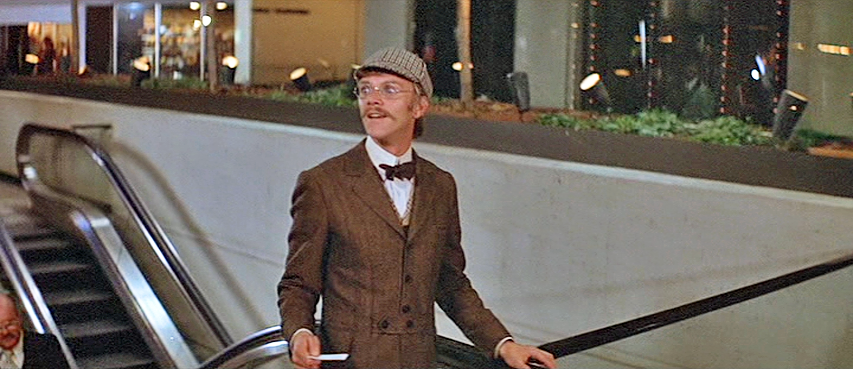
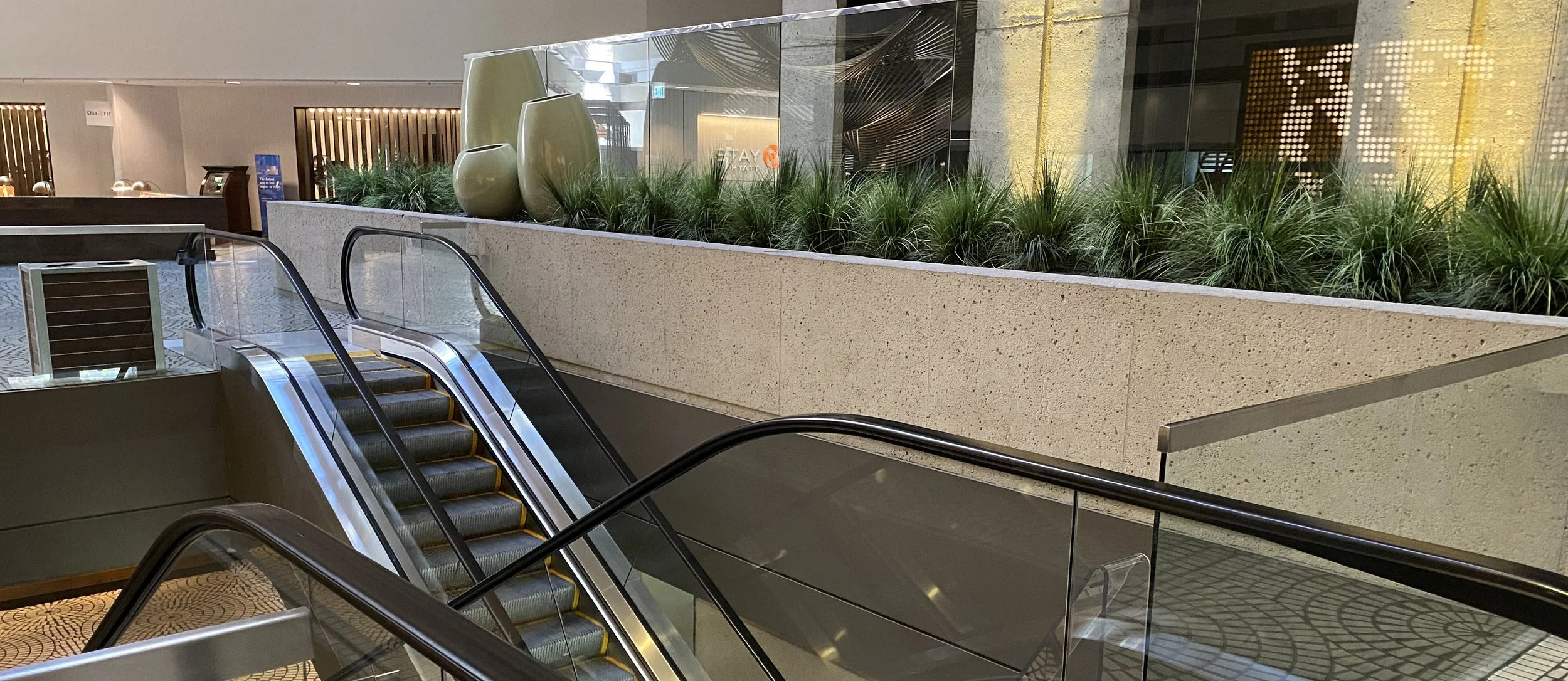
Then … Herbert gazes up in awe as he enters the atrium from street level. (That’s one of the elevators on the right next to the escalator).
… and Now, this is the only escalator serving the atrium - here it is now.
Stevenson can’t believe that Herbert has tracked him down through time.